Showing posts with label Jim Derochea. Show all posts

Wednesday, March 17, 2010

MULTI CHANNEL PUBLISHING SPECIALIST, THE NEW PRINT BUYER

Due to the dramatic down turn in the economy over the last couple of years along with the emergence and adoption of electronic medias, like email, mobile, social networking, podcasting and web self-service, the traditional print buyer role, and print industry in general, is undergoing a dramatic metamorphosis. Since there is a growing, vast array of newer communication channels, with no defined roles or job titles associated with deployment, the role of the traditional print buyer has transitioned to include the understanding and deploying of all of the communication channels.


To date (2010) the terminology has yet to catch up with the industry, though the transformation of such terms as "publishing" (from meaning the printing of books & literature to meaning the deployment of communications (i.e. publish to the web), has helped to spark the transformation of a universally accepted terminology that reflects the new communication technologies, processes and the industry, in general. To wit, W2P used to be known solely as Web-to-Print but is now widely accepted to mean Web-to-Publish, as one example.


Graphic arts and print associations, such as Print Buyers International, are in the process of rebranding in an effort to move this transformation forward, to reflect the new generation of roles and responsibilities of the traditional print production specialist or buyer. Similarly, I positioned myself as the "Multi Channel Publishing Manager" at my last company, to reflect the role and responsibilities that my staff was undertaking over the last 3+ years.


Though the "Print Buyer" is assuming these new roles and responsibilities across the U.S., there is a strong likelihood that the "print buyer" terminology may soon become obsolete, once the communications industry adopts more relevant terminology that appropriately reflects the duties of today's Print Buyer!


My suggestion to Print Buyers??? Make sure you have learned the nuances of the emerging channels, just as well as you have mastered the nuances of print, then start branding yourself as a "Multi Channel Publishing" specialist! It's time to align the diverse skills and expertise of today's Print Buyer/Multi Channel Publishing guru, with an appropriately reflective title to help move the transformation along even even further...


Monday, August 10, 2009

WHAT'S IN A NAME? THE PRINT BUYER'S DILEMMA

by Jim Derochea - Marketing Communications, Solutions, Multi Channel Guru

What's in a name? What's in a title? A lot, if you are in the communications world today, especially if you have anything or had anything to do with printing. For instance, today, "Web" is more than just a kind of roll fed press and "Channels" aren't just for TV anymore while Publish" means much more than what an author aspires to have done with their writings. Case in point, I recently touched upon how the "Publishing" term has evolved and become acceptable as a replacement for the word "print" in several acronyms. Originally viewed as print only applications, it has recently become acceptable to view the terms "W2P" as Web-to-Publish and "VDP" as Variable Data Publishing, to accommodate the inclusion of digital channels. But, in some cases, the industry terminology and "phraseology," is lacking and has not kept up with the changes in the technology & trending landscape that seems to be occurring at a rate equal to the speed of light! Unfortunately, this has led to confusion & misperceptions and can spell pain for those involved.

Lets look at the "Print Buying" industry, for example. Over the last year or two, there have been many changes in the print buying community. Having managed a team of Print Buyers for a number of years, I personally saw a dramatic transformation of the scope and responsibilities for print buyers. Not only does the term, "Print Buyer" no longer accurately describe what many of these professionals do, but, the term has suddenly gone out of vogue as well, as companies look to add newer channels to compliment the print channel. The term, "Print Buyer" or the term "Printer" for that matter, no longer fits, since both the Print Buyer and many commercial Printers have incorporated cutting edge channel technology into their repertoire. Let me back up a minute, to give this subject a little context.

Lets go back in time a bit, to mid-2006 to be exact, when I was in the midst of conducting some personal research into emerging communication technologies and trends. I have always had a strong fascination with technology & trends; "emerging" technology & trends to be precise. No matter what area, what application, I have always loved to learn about new breakthroughs in technology, often picturing if/how it might affect my life or imagining how I could leverage it differently for a different application or how I could leverage a new technology in my work life.

Anyway, around this same time, in 2006, I was challenged to look at the roles & responsibilities of the Print Buyers I managed, to assess whether they could be doing anything differently. The wheels started spinning. I thought about the influx of recent & emerging communication technologies that I had been educating myself on, while also pondering my team's deployment of the millions of collateral touch-points to our customers each year, printed touch-points.

Then, BOOM!!! That's when I was hit with an epiphany, of sorts. A realization regarding the future roles & responsibilities of my team of print buyers, maybe all the print buyers, for that matter. I rationalized that, going forward, we would still need all of those many touch-points to the customers each year, but I deduced that those touch-points could eventually be deployed in diverse ways; deployed through more efficient means via digital channels such as email, web portals, W2P, SMS, etc. The signs were there, but no one (in the organization) had looked that far ahead yet.

In my opinion, this revelation meant that Print Buyers needed to evolve or risk possible career obsolescence in the near future. This became the foundation for my "3-5 year Vision" for the Print Buyers, that included a proactive road map for our "Print Buyers" to follow. A road map that included a training and education schedule, a resource list and a timeline for completion, to help prepare them for the transition into a new, multi channel role.

Looking for validation, I shared this vision with several industry leaders, including Margie Dana, founder of the PRINT BUYERS INTERNATIONAL, who just happens to have great relationships with many of the industry giants. Margie's own research validated the same theory as well, which served to deepen the motivation of my my team. Margie has spoken on this topic in the last 2 years, at numerous graphic arts conferences across the country. In fact, the theme of the Print Buyers International's 2009 Conference, RELEVANCE THROUGH REINVENTION, focuses on that very topic! (The conference is slated for November 3-5, 2009. For more information, you can go to http://www.printbuyersconference.com )

Margie Dana and I have had several discussions over that time and agree that the Print Buyer terminology needs to be re-branded to reflect the actual role & expertise of today's buyer. But the industry has yet to come to a consensus on such terms. "So," you ask, "what's the problem?" Well, many Print Buyers have taken up the challenge over the last year or two and educated themselves on the new, emerging technologies. They have sought to understand the concepts and terminologies of the various channels, to become experts, so that they can feel as comfortable deploying an email campaign as they do deploying a print campaign. In the end, the concepts and the skills needed to deliver quality results for any channel are essentially the same, but, in many cases, the "print buyers" have yet to be recognized in their organizations, as multi-media experts.

Maybe its misperceptions around the "print" aspect of their title or maybe its due to the fact that the industry is in flux due to the speed at which the technology has emerged, without definitive standards, roles and responsibilities being truly defined yet. Or maybe, it is both, with the use of the word "print" in the Print Buyer's title itself, creating a mental barrier for decision makers, who still have the perception that a Print Buyer 'only knows print' which ultimately has stagnated role and responsibility consensus around deployment of multi channel communications.

So, what kind of name change will emerge to supplant the "Print Buyer" term? Media Buyer? Multi Channel Buyer? Channel Communications Buyer? Multi Media Buyers????? Without consensus, I fear many current Print Buyers will be pigeon-holed because of the apparent perception that they are only experts in print that is still out there. Hopefully, events like PBI's 2009 Print Buyers Conference will help to build momentum and exposure for today's Print Buyers, who still hold the key for a smooth transition and adoption of multi channel practices for many organizations. Somehow, a fresher, accepted terminology must catch up to the actual technology and associated practices and roles. And in the case of the "Print Buyer," not only a change in terminology, but a global understanding of their new expertise and new role in today's multiple channel environment!

You can weigh in right now! Click here to go to my poll!

Monday, July 27, 2009

INTEGRATED W2P 2.0, WHERE WERE YOU WHEN WE NEEDED YOU???


by Jim Derochea - Marketing Communications, Solutions, Multi Channel Guru

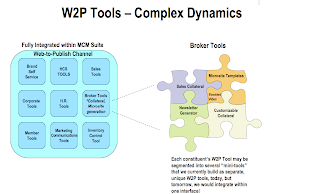
How many of you went through, or are going through, the pain of trying to manage multiple W2P tools for your constituents that were developed by multiple solution providers? The old W2P model went out of vogue before many of us even realized it and for some, it's been a nightmare trying to recover. Where was W2P 2.0 when we needed it???

For a little anecdote, lets go back in time to 2004-2005...
After a number of years of advocating for the adoption of Web-to-Publish solutions within the MarComm Department that I worked for at the time, in hopes of streamlining many of our repetitive "down and dirty" jobs and campaigns, there was finally a breakthrough. The company gave the thumbs-up to adopt W2P technology and we immediately started brainstorming. After collaborating with other MarComm leaders on a list of potential W2P tools that included many constituent-facing, self-service W2P solutions, I quickly deduced that the 2004 W2P landscape was outdated for our needs. To me W2P was a distinct channel, just like email or print and thus, needed to be addressed as such, as opposed to addressing it as many individual solutions.

For many years, the Printers provided the W2P services that gave the users a quick way to order materials. It was simple, providing a simple branded interface to order stationery, for example. It made sense for the Printer, because it drove print and it made sense for customers, because it streamlined the ordering process and helped to control costs. But our needs were exponential and I immediately raised the red flag!

I looked at the potential individual W2P needs that were now on my plate. Our constituents, both internal & external, were very unique and needed access to specific assets & needed unique functionality from all other constituents. The prevailing suggestion at the time was to seek out an optimal vendor/solution for each constituent's needs and build a unique W2P Self-Service tool for each. But this would not streamline anything...Some of the W2P providers only provided print output, while others provided the ability to produce static electronic assets only, while others could provide variable assets electronically, but didn't cross over to the print side well or vice-versa. Some offered canned solutions that met a specific need perfectly, while others provided Developers to customize the solution to suit our needs. I acknowledged that this would provide us with a robust, perfectly molded solution for each of our W2P projects, but would be very costly and would lead to severe "unintended consequences" down the road if we chose to use different solution providers to build the array of W2P tools for us. Unintended consequences such as having little to no integration between W2P solutions or little chance of leveraging one W2P solution for another constituent's solution later on or individual solutions not offering scalability for us as our business needs expanded. Since we did not have an Digital Asset Library, we also had no logical way to "feed" each W2P tool with the most current assets, except to try to manage it manually, which would have been a full-time, major undertaking in itself. And simplistically, I could foresee some poor Sales Executive, a Broker of ours or an inside Customer Service associate having to remember many different website addresses and having to log on to each site separately, to conduct their business. As much as the W2P technology was the best answer to solve each individual constituent's 'problem', the summate of the solutions was poised to create far more problems than they solved.

So, I sought out industry experts, many of who seemed as perplexed as I was at the time. As gratifying as it was to get their acknowledgement for being such a forward-thinker, it didn't net me any substantial leads. I eventually drew up a couple of proposals to try to avoid going down a path of unintended consequences.

The first proposal would only be a cosmetic band-aid to help our constituents navigate the various W2P solutions which involved the building of a permissions based, branded portal that would simply be a 'warehouse' of our individual W2P tools.
Users would be given access only to the W2P solutions that they had permission to utilize and the rest of them would be suppressed. But it lacked full integration, especially to share assets and to compile aggregate reporting data. The second was more daring and involved the same permission based branded portal idea, combined with the building and implementation of a robust DAM system to "feed" the various W2P tools as well as a rules based reporting filter that compiled the W2P data from each tool, into a master file.


Unfortunately, economics and timing ruled and neither proposal saw the light of day, but it raised my awareness that the W2P model of yesterday needed to change and change rapidly. The days of offering only specialized W2P solutions was quickly reaching it's end. Companies needed W2P solutions that not only streamlined & managed their print and inventories, but they needed Web-based (W2P) tools to allow access to specific assets and functionality to various internal and external constituents across multiple channels and they needed it all integrated.
Back then, we needed Web-to-Publish 2.0!!! (notice I use the word "publish" because the use of W2P technology transcends print and encompasses the deployment of both print and electronic assets these days!)

Today, 5 years later, more and more solution providers are offering W2P solutions that are fully or nearly fully integrated, so though it may take some digging, there are integrated W2P solutions out there. Some now call them W2P 2.0 solutions. Many of the EMM or MCM Suites now have this capability as well, so if you are also looking to integrate campaign management, deployment across channels, robust reporting, CRM, etc, as well as to integrate your W2P tools, then one of these solutions are worth a look!

So, if you have not taken a look at your W2P plans in terms of future scalability and integration, maybe now is a good time to do so. Proposing a plan to the right leaders during these fragile economic times, that will truly make your organization more efficient, agile, integrated and intelligent, surely can't hurt your relevance to the organization!
Go Web 2.0! :-)

Tuesday, July 14, 2009

IS W2P ALREADY BECOMING OUTDATED?

by Jim Derochea - Marketing Communications, Solutions, Multi Channel Guru

Well, the term “Web-to-Print” (W2P) certainly seems to be outdated, though the technology is here to stay, in one form or another. It is a similar dilemma that “Print Buyers” and related fields and associations have been faced with over the last several years. Attempts to re-brand themselves with a more apropos moniker over the last several years to better reflect the inclusion of multiple communication channels have not proven fruitful…yet. In fact, I know of many “Print Buyers” who, despite having re-invented themselves as gurus of Multi Channel deployment, have been displaced during economic downsizing in large part because of the stigma attached to the word “Print” in their job title and the need for these companies to seek less expensive forms of communicating. Ironic! But that’s a story for another day.

As for W2P, I have been referring to the acronym, W2P as WEB-TO-PUBLISH, the last several years, just as I have referred to VDP as VARIABLE DATA PUBLISHING, rather than Variable Data Printing. I believe that the term, “publishing” has evolved and has been accepted in the industry, to now encompass most types of deployment, including deploying email, posting to web as well as print.

Of course, there are still many otherwise knowledgeable communication specialists and leaders out there who get confused when someone suggests W2P as a solution to provide their constituents with access to digital content/information because they still think of W2P and VDP as “Print” solutions only.

So, its up to all of us to spread the word, because WEB-TO-PUBLISH tools are only going to become more prevalent in this economic climate of fiscal awareness, along with the current pressure for companies to Go Green!


Jim Derochea

Friday, July 10, 2009

RELEVANT COMMUNICATIONS: ROADBLOCKS TO UNIVERSAL ADOPTION

by Jim Derochea - Marketing Communications, Solutions, Multi Channel Guru

I was recently asked, “why hasn't highly relevant communications become more prevalent in the marketplace?” There is no single answer, but, instead, intertwined obstacles that have stymied universal adoption. However, help may be on the way...

In my opinion, there are two main roadblocks to mainstreamed adoption of highly relevant communications. One of the biggest factors is still overall cost or perceived cost to produce highly relevant communications compared to traditional communications, particularly given the economic state that we have been in over the last several years.

The other factor is the shortage of skilled VDP (Variable Data Publishing) Marketing Specialists who truly understand that true relevancy usually needs to be transparent to the receiver, otherwise, it tends to come of as gimmicky, intrusive or even uninteresting and irrelevant. This shortage of talent also comes into play as a factor in cost, because companies either have to pay to secure this expertise through a 3rd party or they must be able to justify the cost to hire their own full-time expert, while creating enough demand to justify their position. Ultimately, cost seems to be the overriding factor, with the talent/expertise issue being a main component of overall cost, but at the same time, is an important issue unto itself. Understanding these two roadblocks and dealing with them separately is not always easy, but companies need to address and conquer both of these issues, in order to begin to transform their communications into more impactful, highly relevant conversations with their constituents, across multiple channels.

  • COST FACTORS & MYTHS:

The cost to buy, mine and manage data, even the company's own data, is one cost factor, especially for companies that have not invested in strong, integrated enterprise data technology solutions. Besides those obvious costs surrounding data, there are other significant pieces of the puzzle that affect the costs per communication that are paramount to successful personalization. One of these major pieces of the puzzle revolve around the depth & quality and the subsequent analysis of that data to determine what data elements to use & how to use them for the best "impact" with their constituents. As previously noted, a company has to either pay for a third party (agency?) to do this for them or hire highly competent associate(s) to accomplish this. It may be cost prohibitive for a company to hire a staff for this function, if the company does not plan to continuously pump out relevant communications. I feel that, to be effective, companies need to commit to making relevant communications a part of their communication fabric. If done correctly, it should be neither cost prohibitive or labor intensive. Au contraire, if done correctly, it should reap a high ROI and should create efficiencies across the board.

The "perceived" cost per piece for printed personalized communications is also a factor, especially in cases where Marketing Directors and/or Finance Directors don't understand the overall potential effectiveness (ROI) of such campaigns versus traditional static print. This may also be true when they don't have first-hand experience with actual campaigns and campaign results or don't believe that "relevance" will make a difference to their constituents. To this point, I witnessed several Marketing Directors and VP's several years ago at a highly respected personalization conference, discussing how they weren't using personalization because the cost per piece was too high and they couldn't sell it to their Finance Leaders. They did not know how to accurately communicate the costs/ROI benefits of targeted, relevant communications versus a one-size-fits-all mass communications model and therefore had little chance of getting buy-in from their Finance Leaders. I believe the needle has moved slightly since then, through education and cultural acceptance, but there still is much work to be done.

On the upside, I do think that the trend towards electronic communications such as email and the internet, has taken a slight chunk out of the cost issue, since it is theoretically less expensive to send a personalized E-Communication via email or a personal web portal, than to send a personalized printed communication. This has opened the door for many Marketers to adopt relevancy in their E-Communications, though the economy has still likely caused many companies to hesitate in adopting such practices.

  • TALENT:

Based on industry researchers and based on my experiences and research, it seems that there is not enough consistent, in-depth analytics of data being applied to relevant communications in the marketplace. This could be due to a shortage of the analytic gurus who understand how to effectively use data to hit the communication mark by eliciting specific "emotional connections & actions" from consumers through effective relevancy and messaging. It could also be because many companies still don't fully understand this concept of effective, transparent relevancy and opt for gimmicky interchangeable imagery and personal content or may just be that this concept is still so very new and companies are trying to learn as they go.

We all have seen numerous cases of personalized communications over the last several years. Some really bad, some eye-catching & some even relevant. But the best communications are usually the ones we may not immediately identify as a personalized communications. The content and message is based on personal preferences and other personal data, but is not obvious or intrusive. Several years ago, I attended a VDP workshop, where the instructor gave an exquisite example of such a campaign. I have changed the concept details slightly and left out some detailed information, as to not infringe on the company copyrights or to come off as an advertisement for them.

  • EXAMPLE: Effective & transparent use of relevancy

The instructor's son was all excited and came to his father to ask him to sign him up for a particular roadside service. Wondering what got his son all excited, the instructor asked his son why the sudden urgency and excitement to sign up for such a service. The son reached into his back pocket and pulled out a postcard he had received in the mail from this roadside service company. At first glance, it looked benign, with the only apparent personal information being in the form of the standard name & address in the mailing area. The son excitedly began to tell his father about the service. "It says," the son started, "Have you ever broken down and had to have your vehicle towed? Dad, I was just towed, like 2 weeks ago!" The son went on reading the postcard, "Even if you only were towed 15 or 20 miles, it could cost you up to $100 for towing service." The son then explained how he got towed to a repair station, 18 miles from where he broke down and it cost him $90 in towing fees. The ad went on to highlight how he would never have to pay for towing again, if he was a member of their roadside service. The son exclaimed, "If only I received this a couple of weeks ago and became a member, I wouldn't have had to use my meal money for school to pay for the tow!"

Being somewhat of a VDP guru, the instructor suspiciously took the postcard and after a few phone calls, determined that this was NOT a coincidence that his son got this postcard, but it was actually a very transparent, yet effective use of personal data that had been recently collected. He found out that this particular roadside service company had partnered with numerous towing companies in a specific region of their state. They asked the participating tow companies to collect and send them the basic information of any non-members on a weekly basis, that they had to tow, along with date of tow, miles towed and total cost of the tow. To the casual recipient, it appeared to be a timely coincidence that they received this postcard fresh off the nightmare of being towed, when in fact it was a succinct, effective and transparent use of relevant data. It also highlighted that you don’t necessarily need a ton of data, just the right data that is relevant to your message and the action you are trying to influence from your constituents.

  • CONCLUSION: Help is on the way…

So, how will we get there? How will we get to the point where the use of use of relevancy in communications is commonplace? I believe that there is a perfect storm brewing for enabling technology and solution providers to flourish as we move out from under the dark economic cloud. As companies regain their footing and regain their confidence in the economy, they will be looking to make investments in technology that will empower them to create & deliver more impactful, relevant messages while streamlining their communication processes and allowing them, as marketers, to be much more efficient and agile.

There are already many such enabling technology solutions out there offered by companies like InterlinkOne, Neolane, CGX, PPI Solutions, Unica, TFC and Aprimo to name a few. These companies offer robust Multi Channel Marketing Suites or Enterprise Marketing Management Suites that include all of the marketing tools needed to easily develop, deploy and measure relevant communications and campaigns across all channels, including incorporating variability to any communication. Most of these companies offer solutions that integrate a Digital Asset Library, Rules Engine, Marketing Mart Database and Reporting Analytics to help companies produce & manage all Communications and Campaigns (Campaign Management) that can be deployed across Multiple Channels. Creating once, using often, across any channel while having the ability to report and analyze the effectiveness of communications so that the data can then be used to influence future communications. Imagine doing what you do today, communication-wise, but with the ability to do it more efficiently and with much more impact, speed and relevance. Once adopted, Marketers will quickly realize how simple, yet powerful, these technology solutions are and how cost effectively they can produce, track & analyze robust communications and campaigns.

The time is right, it’s the perfect storm, for companies to partner with or adopt these enabling technology solutions as the economy begins to recover. Then, we will begin to see a wave of innovative, highly relevant communications, that will soon become more and more prevalent in the communication world.

Jim Derochea